





Table of Contents
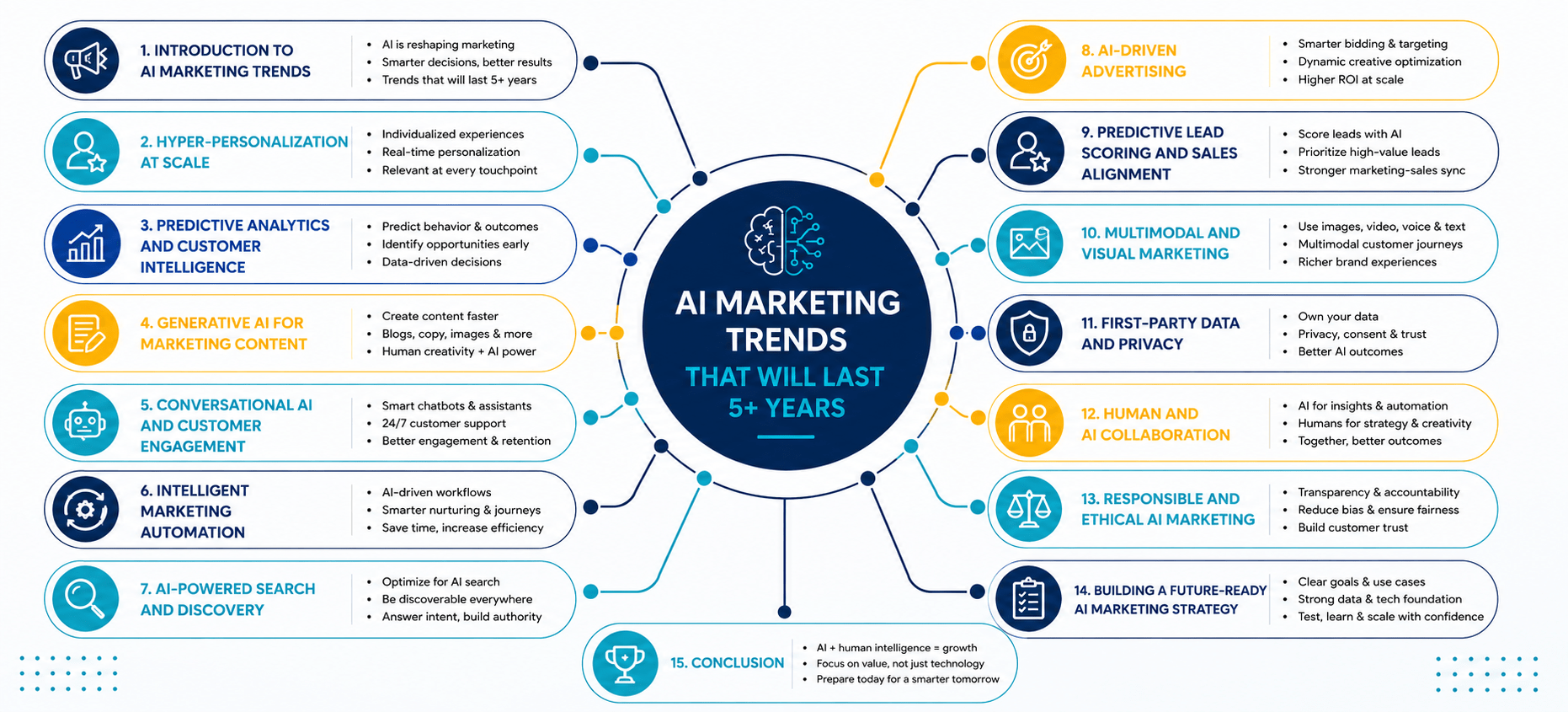
- Introduction to AI Marketing Trends
- Hyper-Personalization at Scale
- Predictive Analytics and Customer Intelligence
- Generative AI for Marketing Content
- Conversational AI and Customer Engagement
- Intelligent Marketing Automation
- AI-Powered Search and Discovery
- AI-Driven Advertising
- Predictive Lead Scoring and Sales Alignment
- Multimodal and Visual Marketing
- First-Party Data and Privacy
- Human and AI Collaboration
- Responsible and Ethical AI Marketing
- Building a Future-Ready AI Marketing Strategy
- Conclusion
1. Introduction to AI Marketing Trends
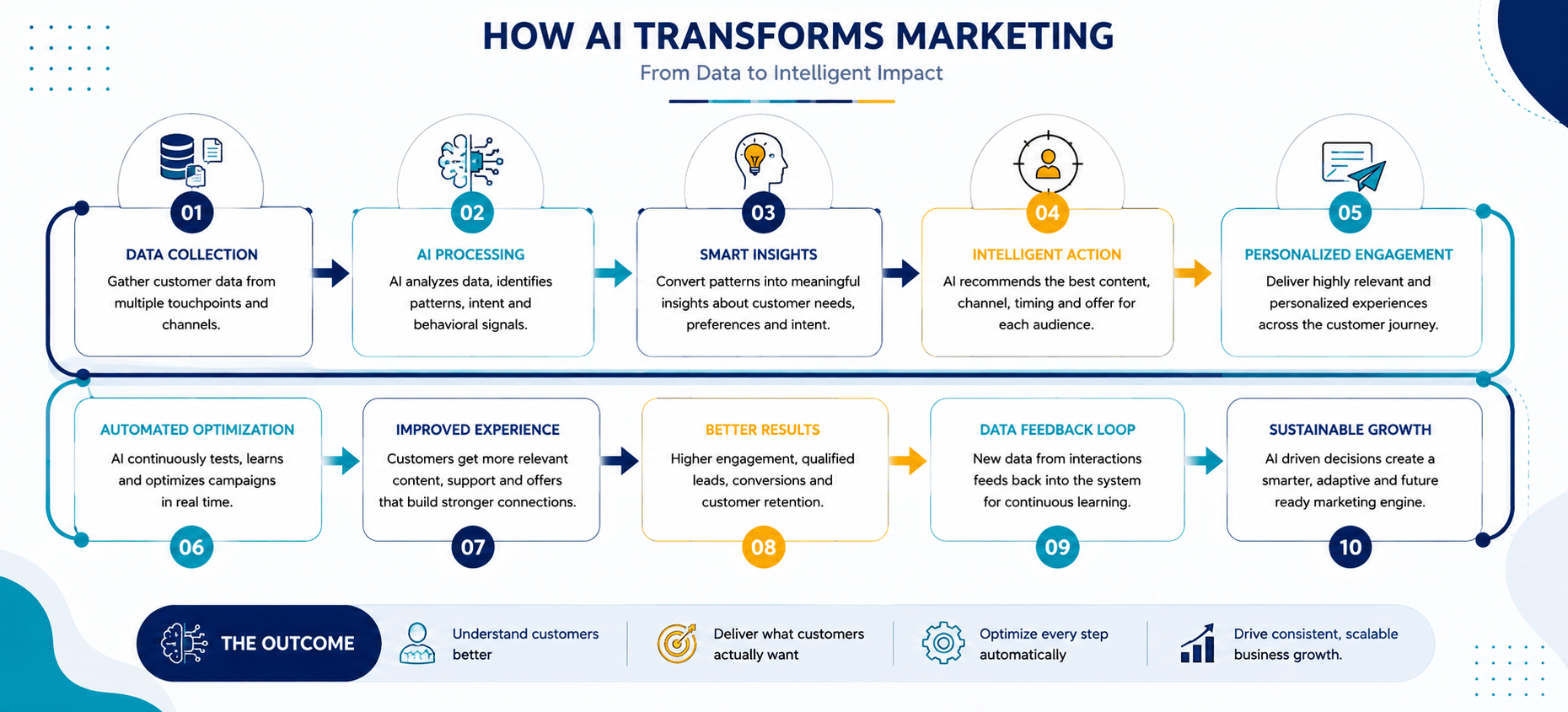
Artificial intelligence is rapidly becoming one of the most influential forces in digital marketing. What started with basic automation and recommendation engines has evolved into sophisticated systems capable of analysing customer behaviour, generating content, predicting demand, personalizing experiences and supporting marketing decisions at scale.
The most important AI Marketing Trends are not simply temporary technology trends. They represent fundamental changes in how businesses understand customers, create campaigns and manage digital experiences. As AI capabilities continue to improve, marketers are moving from experimenting with individual AI tools to integrating artificial intelligence across their complete marketing ecosystem.
The Future of AI Marketing will be defined by smarter personalization, predictive intelligence, automated decision-making and stronger collaboration between humans and intelligent systems. Businesses that build these capabilities today will be better prepared for how customers discover, evaluate and interact with brands in the years ahead.
This guide explores the AI Marketing Trends that are likely to remain relevant for the next five years and beyond, while explaining how businesses can incorporate them into a sustainable AI Marketing Strategy.
2. Hyper-Personalization at Scale
Personalization has been part of digital marketing for years, but artificial intelligence is significantly increasing its sophistication. Instead of dividing customers into broad audience segments, AI allows brands to create experiences based on individual behaviour, interests, purchase history and real-time intent.
AI Powered Marketing systems can process large volumes of customer data and determine which products, messages, offers or content are most relevant to each individual.
AI-powered personalization can include:
- Dynamic website experiences based on visitor behaviour
- Personalized product and service recommendations
- Individual email content and subject lines
- Customized advertising messages
- Personalized offers and promotions
- Content recommendations based on interests
- Real-time customer journey optimization
For example, an ecommerce business can analyse browsing history, previous purchases and current behaviour to recommend products that are most relevant to an individual shopper. A B2B company can personalize website content according to a visitor’s industry, company type or stage in the buying journey.
Hyper-personalization is likely to remain one of the strongest AI Marketing Trends because customers increasingly expect digital experiences to be relevant to their individual needs.
3. Predictive Analytics and Customer Intelligence
Traditional marketing analytics focuses heavily on understanding what has already happened. Predictive analytics takes marketing intelligence further by using historical and real-time data to estimate what customers are likely to do next.
AI models can analyse thousands of behavioural signals and identify patterns that would be difficult for marketers to detect manually. These insights allow businesses to make faster and more informed marketing decisions.
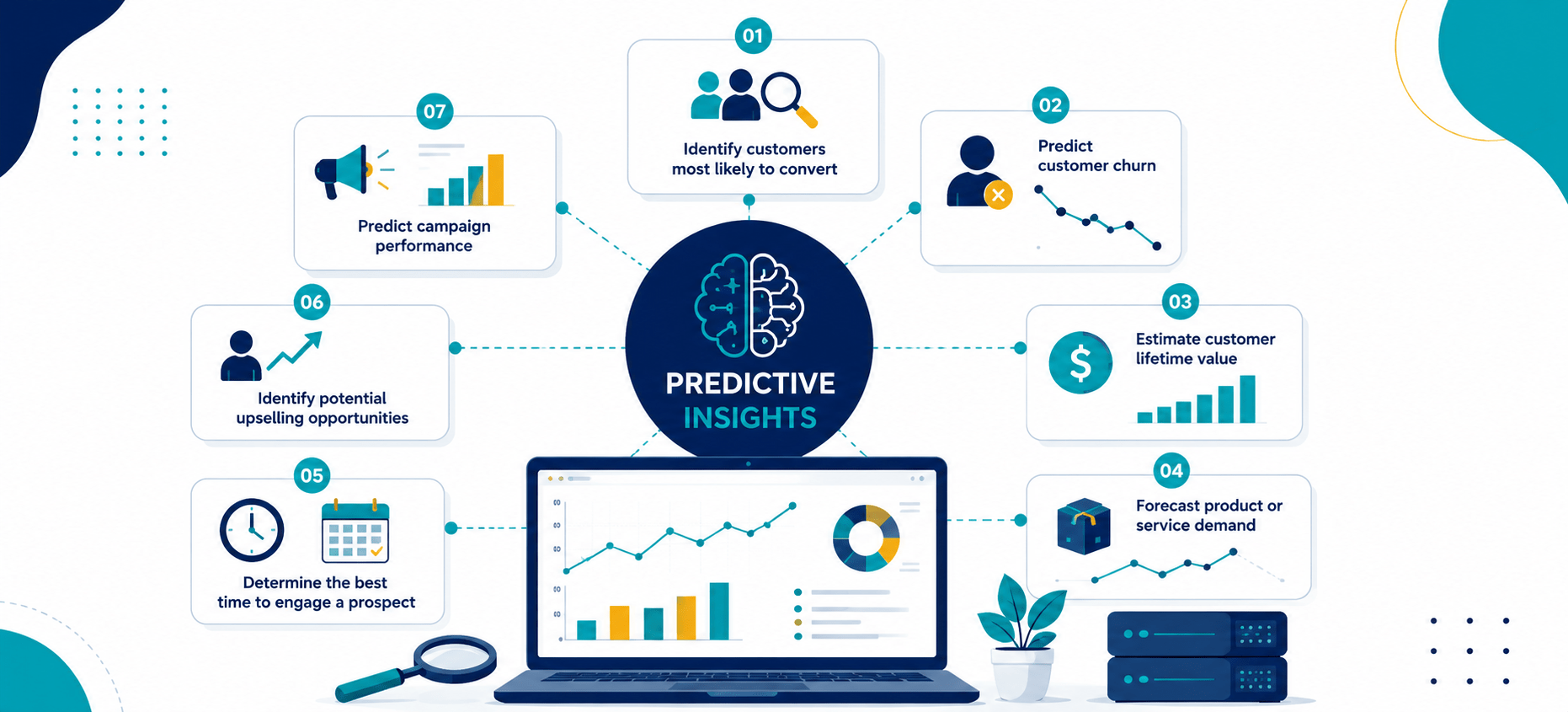
Predictive analytics can help businesses:
- Identify customers most likely to convert
- Predict customer churn
- Estimate customer lifetime value
- Forecast product or service demand
- Determine the best time to engage a prospect
- Identify potential upselling opportunities
- Predict campaign performance
For marketers, this means moving from reactive decision-making towards proactive marketing. Instead of waiting for a customer to disengage, an AI system may identify early warning signals and trigger a relevant communication or retention offer.
Predictive customer intelligence will remain central to AI Driven Marketing because businesses will continue looking for ways to anticipate customer needs rather than simply responding to past behaviour.
4. Generative AI for Marketing Content
Generative AI has transformed how marketing teams research, develop and repurpose content. AI can support marketers in creating blogs, emails, advertising copy, product descriptions, social media posts, images, video scripts and other marketing materials.
The long-term value of generative AI is not simply producing more content. Its greater potential lies in helping marketers create relevant content faster and adapt it for different customers, channels and stages of the buying journey.
Common applications include:
- Topic and keyword research
- Content ideation and outlines
- First drafts of marketing content
- Advertising copy variations
- Email campaign content
- Product descriptions
- Content repurposing
- Localization for different markets
However, increasing access to generative AI also means that generic content is easier to produce. Brands will therefore need to differentiate themselves through original research, customer insights, expert opinions, case studies and unique brand perspectives.
A strong AI Marketing Strategy should treat generative AI as a creative and productivity assistant rather than a complete replacement for human expertise.
5. Conversational AI and Customer Engagement
Conversational AI is changing how customers communicate with businesses. Modern AI assistants can understand natural language, interpret context and maintain more sophisticated conversations than traditional rule-based chatbots.
This makes conversational AI useful throughout the customer journey, from initial product discovery to post-purchase support.
Businesses can use conversational AI to:
- Answer frequently asked questions
- Recommend suitable products or services
- Qualify potential leads
- Schedule appointments or consultations
- Provide order and delivery information
- Assist customers with product selection
- Collect feedback and customer insights
Conversational experiences can also provide marketers with valuable information about the questions customers ask, the problems they experience and the factors influencing their purchase decisions.
As AI in Marketing develops, conversational interfaces are likely to become a standard part of websites, applications and digital customer experiences.
6. Intelligent Marketing Automation
Marketing automation has traditionally depended on predefined rules. A customer completes an action, such as downloading a guide, and an automated email sequence begins.
Artificial intelligence is making these systems more adaptive. Instead of simply following fixed workflows, AI can analyse customer behaviour and determine the most appropriate next action.
Intelligent marketing automation can support:
- Automated customer segmentation
- Personalized email journeys
- Lead nurturing
- Campaign scheduling
- Audience optimization
- Content recommendations
- Campaign performance monitoring
- Automated reporting and insights
For example, two customers who download the same resource may receive different follow-up experiences based on their previous interactions, industry, engagement level or purchase intent.
AI Powered Marketing automation can therefore help businesses create more responsive customer journeys while reducing repetitive manual work for marketing teams.
7. AI-Powered Search and Discovery
The way people discover information online is changing. Traditional search engines are increasingly incorporating AI-generated responses, while conversational AI platforms allow users to ask detailed questions and receive direct answers and recommendations.
This evolution means businesses must think beyond conventional keyword rankings. Content needs to be structured so that both people and AI systems can easily understand its meaning, expertise and relevance.
Businesses should focus on:
- Answering specific customer questions clearly
- Creating comprehensive and well-structured content
- Publishing original research and expert insights
- Maintaining accurate business and product information
- Building strong topical authority
- Using relevant structured data
- Keeping important content updated
- Strengthening brand credibility across digital channels
The Future of AI Marketing will increasingly involve optimizing digital information for both traditional search engines and AI-powered discovery platforms.
8. AI-Driven Advertising
Digital advertising platforms already rely heavily on machine learning for bidding, audience targeting, placements and campaign optimization. Over the next several years, AI is expected to play an even greater role in managing advertising decisions.
AI Driven Marketing allows advertising systems to analyse large numbers of signals in real time and identify the combinations of audiences, creatives, placements and bids most likely to generate results.
AI-driven advertising can support:
- Automated bidding strategies
- Audience discovery and expansion
- Dynamic creative optimization
- Budget allocation
- Conversion prediction
- Cross-channel campaign optimization
- Creative performance analysis
Automation does not eliminate the importance of marketing strategy. AI systems still require accurate conversion tracking, quality data, strong creative assets and clearly defined campaign objectives.
Successful marketers will increasingly focus on providing AI advertising platforms with the right strategic inputs while allowing intelligent systems to manage complex optimization at scale.
9. Predictive Lead Scoring and Sales Alignment
Traditional lead scoring often assigns fixed values to actions such as opening an email, downloading a document or visiting a pricing page. AI can create more sophisticated models by analysing a much wider range of behavioural and customer signals.
Predictive lead scoring can identify which prospects are most likely to become customers and help sales teams prioritize their efforts accordingly.
AI-powered lead intelligence can analyse:
- Website activity
- Content engagement
- Email interactions
- Company characteristics
- Previous customer patterns
- Purchase intent signals
- Historical conversion data
This creates stronger alignment between marketing and sales because both teams can focus on opportunities with the greatest potential value.
For B2B companies in particular, predictive lead intelligence can become an important component of a broader AI Marketing Strategy focused on improving lead quality rather than simply increasing lead volume.
10. Multimodal and Visual Marketing
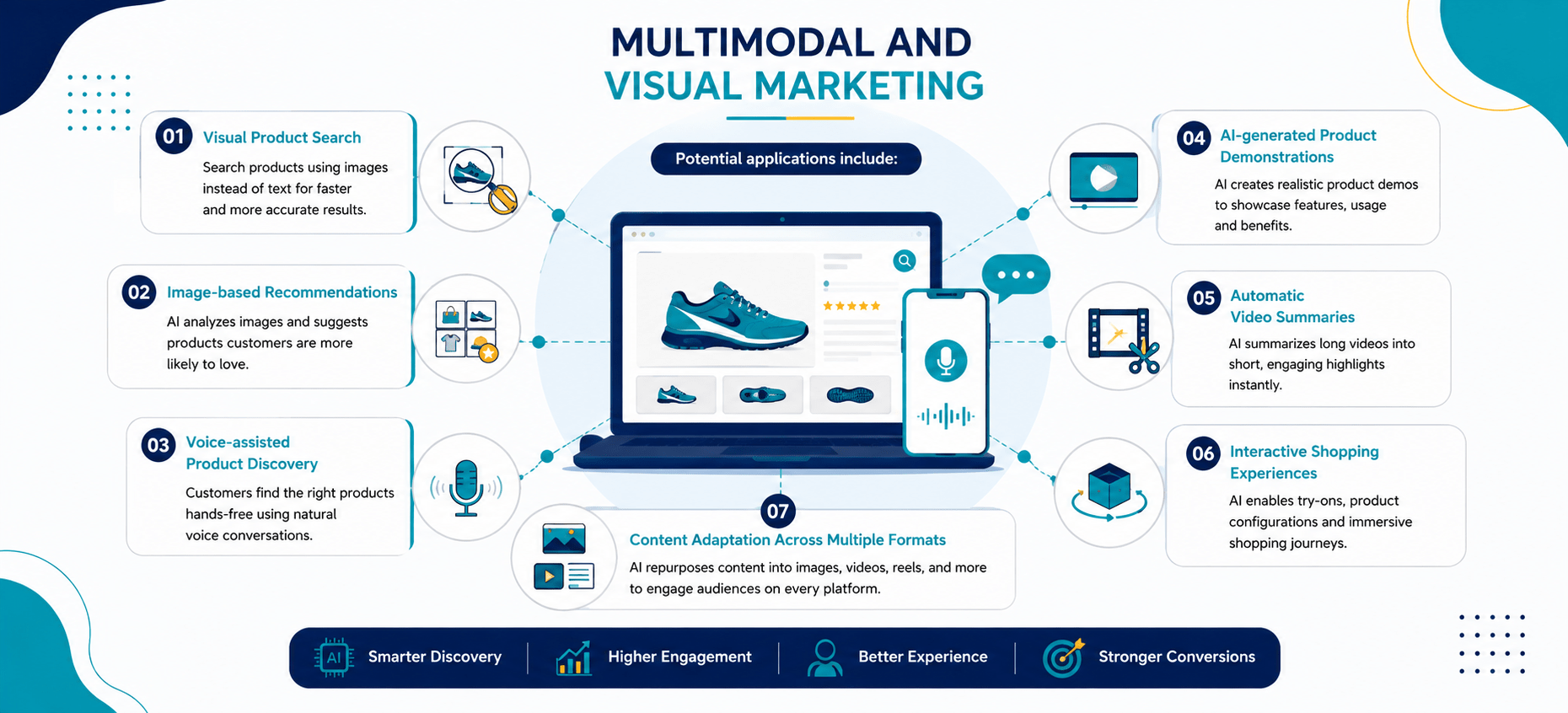
Artificial intelligence is increasingly capable of understanding and generating multiple forms of information, including text, images, video and audio. This development is creating new possibilities for multimodal marketing.
Customers may begin a product search with an image, continue the interaction through voice and then ask detailed questions through text before making a purchase decision.
Potential applications include:
- Visual product search
- Image-based recommendations
- Voice-assisted product discovery
- AI-generated product demonstrations
- Automatic video summaries
- Interactive shopping experiences
- Content adaptation across multiple formats
For marketers, this means content strategies will increasingly need to extend beyond written pages. Images, videos, audio and interactive experiences will become more connected parts of the same customer journey.
Multimodal experiences are therefore likely to become an increasingly important part of AI Powered Marketing as consumers adopt more natural ways to interact with digital platforms.
11. First-Party Data and Privacy
The quality of any AI system depends heavily on the quality of the data available to it. At the same time, businesses face increasing expectations around customer privacy, transparency and responsible data use.
This makes first-party data particularly valuable. First-party data is information businesses collect directly through their own customer interactions.
Sources can include:
- Website registrations
- Customer purchases
- CRM information
- Email engagement
- Customer surveys
- Loyalty programmes
- Application activity
- Customer service interactions
Businesses with accurate and well-organized first-party data will be better positioned to use artificial intelligence for personalization, customer intelligence and campaign optimization.
However, a sustainable approach to AI in Marketing requires more than collecting data. Businesses need clear consent practices, appropriate security measures and transparent policies explaining how customer information is used.
12. Human and AI Collaboration
One of the most important long-term AI Marketing Trends is not a specific technology but the changing relationship between marketers and intelligent systems.
AI excels at processing large datasets, detecting patterns, generating variations and performing repetitive activities. Humans remain stronger in areas requiring creativity, empathy, cultural understanding, strategic judgement and relationship building.
AI can support marketers with:
- Data analysis
- Pattern recognition
- Content variations
- Campaign monitoring
- Research and summarization
- Repetitive workflow automation
Human marketers remain essential for:
- Brand strategy
- Original creative concepts
- Emotional storytelling
- Cultural understanding
- Ethical judgement
- Customer relationships
- Final strategic decisions
The most effective AI Driven Marketing teams will therefore combine machine intelligence with human expertise rather than treating them as competing alternatives.
13. Responsible and Ethical AI Marketing
As businesses rely more heavily on artificial intelligence, responsible AI practices will become increasingly important. AI-generated content, automated decisions and customer data processing can introduce risks if they are implemented without appropriate oversight.
Potential challenges include inaccurate information, biased recommendations, misuse of customer data, misleading content and unclear accountability for automated decisions.
A responsible AI framework should include:
- Human review for important customer-facing content
- Clear data privacy standards
- Regular checks for inaccurate AI outputs
- Processes for identifying potential bias
- Protection of confidential information
- Approved AI tools and usage policies
- Clear accountability for automated decisions
Responsible AI is not only about reducing risk. It can also strengthen customer trust. Businesses that clearly demonstrate responsible use of AI may differentiate themselves as customers become more aware of how artificial intelligence influences their digital experiences.
14. Building a Future-Ready AI Marketing Strategy
Businesses do not need to adopt every AI tool or trend immediately. A successful AI Marketing Strategy should focus on business problems where artificial intelligence can create measurable value.
Start with business objectives
Identify specific challenges such as inefficient content production, poor lead quality, high customer churn, low conversion rates or excessive manual campaign management.
Strengthen your data foundation
Review how customer and campaign data is collected, stored and connected. AI cannot consistently produce reliable insights when the underlying data is incomplete or inaccurate.
Choose high-impact AI applications
Prioritize applications that can directly improve customer experience, marketing efficiency or revenue rather than implementing technology simply because it is new.
Run controlled experiments
Start with a limited campaign, workflow or customer segment. Measure performance against the existing process before expanding the technology.
Maintain human oversight
Create clear approval processes for customer-facing content, strategic decisions and sensitive applications of customer data.
Measure meaningful outcomes
Track metrics such as qualified leads, conversion rates, customer retention, revenue, customer lifetime value and time saved rather than measuring AI adoption itself.
Build AI capabilities within your team
Marketing teams should develop practical skills in AI tools, prompt development, data interpretation, output verification and responsible AI use.
A flexible and business-focused approach will help organizations adapt as technology evolves without becoming dependent on individual platforms or short-lived AI Marketing Trends.
15. Conclusion
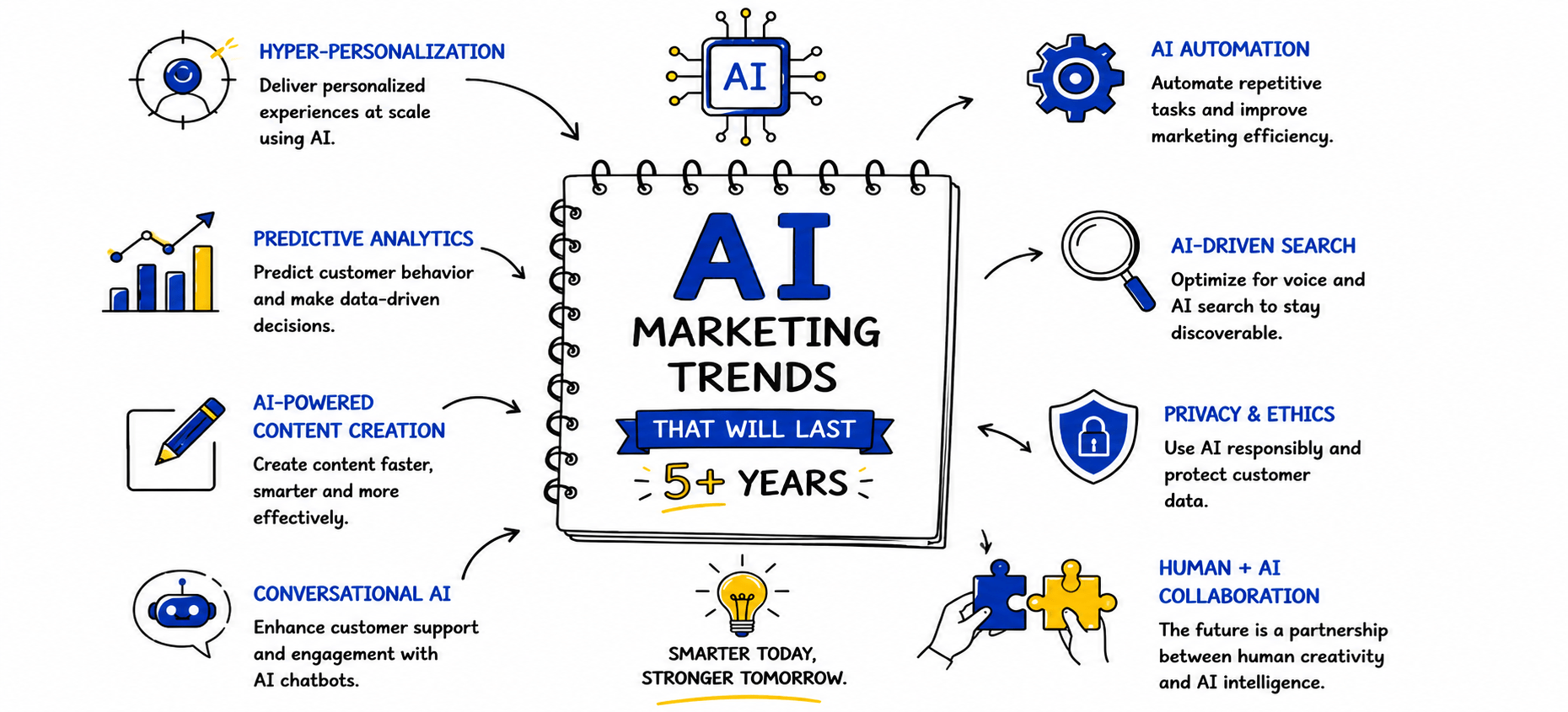
Artificial intelligence is changing marketing at a fundamental level, but the most valuable developments are those that solve long-term business and customer challenges. Personalization, predictive analytics, generative AI, conversational experiences, intelligent automation and AI-powered discovery are likely to remain important well beyond the next five years.
The Future of AI Marketing will increasingly involve AI working throughout the customer journey, helping businesses understand intent, personalize experiences, improve campaigns and make faster decisions.
However, successful AI in Marketing will require more than simply adopting new tools. Businesses need strong data foundations, clear objectives, responsible AI practices and human expertise to turn technology into meaningful business outcomes.
Organizations that build a thoughtful AI Marketing Strategy today will be better prepared for future changes in customer behaviour and digital technology. The goal of AI Powered Marketing should not be to automate everything, but to use intelligence where it improves relevance, efficiency and customer experience.
Ultimately, the strongest AI Driven Marketing strategies will combine the speed and analytical power of artificial intelligence with the creativity, judgement and empathy of human marketers.


 17
17