


Table of Contents
Click to Show/Hide Table of Contents
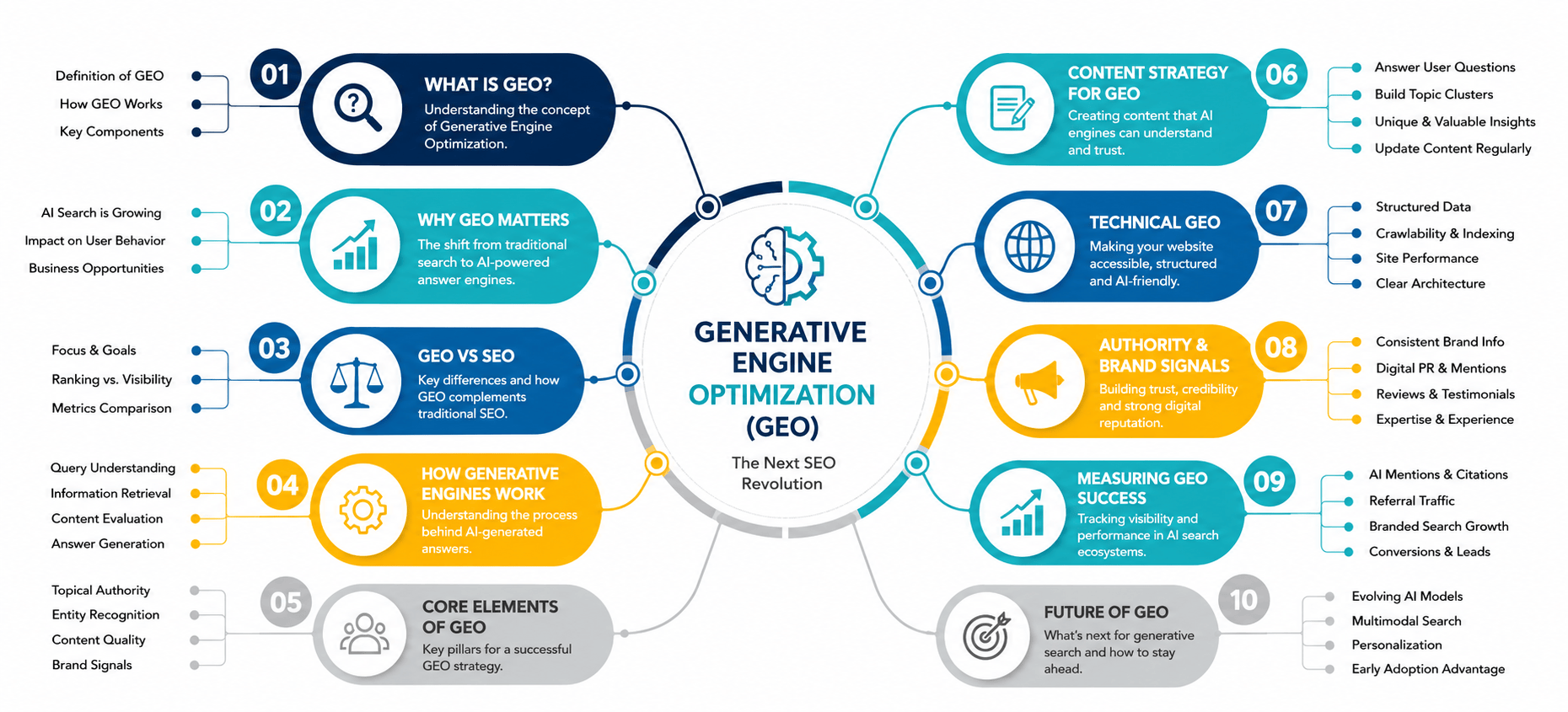
- What Is Generative Engine Optimization (GEO)?
- Why GEO Is the Next SEO Revolution
- GEO vs SEO: What Is the Difference?
- How Generative Engines Work
- Why Businesses Need GEO
- Core Elements of a Successful GEO Strategy
- Content Strategy for Generative Engine Optimization
- Entity Authority, Brand Signals, and Digital Reputation
- Technical GEO: Making Content AI-Friendly
- GEO Keyword and Query Research
- How to Optimize for ChatGPT, Gemini, and AI Search Engines
- A Practical GEO Content Framework
- How to Measure GEO Performance
- Common GEO Mistakes to Avoid
- GEO for Ecommerce and D2C Brands
- GEO for B2B and Service Businesses
- The Future of GEO and Search Marketing
- Step-by-Step GEO Action Plan
- Frequently Asked Questions About GEO
- Conclusion: Preparing Your Brand for the Generative Search Era
What Is Generative Engine Optimization (GEO)?
Generative Engine Optimization, commonly known as GEO, is the practice of optimizing digital content, websites, brand information, and online authority so that a business has a greater chance of being understood, referenced, summarized, recommended, or cited by artificial intelligence-powered search and answer engines.
Traditional search engine optimization focuses heavily on improving visibility in search engine result pages. GEO expands this objective by focusing on environments where users may receive a complete synthesized answer instead of a traditional list of webpages.
Generative search systems can analyze information from multiple sources, interpret a user’s intent, compare entities, identify relevant evidence, and generate a conversational response. Because of this shift, marketers must think beyond ranking a webpage for a keyword. The new question is whether an AI system understands your brand well enough to include it in the answer.
GEO therefore combines many existing digital marketing disciplines, including SEO, content marketing, digital PR, entity optimization, technical SEO, structured data, reputation management, topical authority, and brand building.
A simple way to understand GEO
SEO asks: “How can my webpage rank higher?” GEO asks: “How can my brand become a trusted source that generative engines understand and reference when answering relevant questions?”
This distinction is important because AI-powered discovery is increasingly conversational. Users are asking detailed questions such as “Which ecommerce platform is best for a growing D2C brand?”, “What should I look for when choosing an SEO agency?”, or “How can I reduce customer acquisition costs?” These queries often require explanations, comparisons, recommendations, and context rather than a single keyword-based result.
GEO is designed to prepare content for this new discovery environment while still supporting traditional organic search performance.
Why GEO Is the Next SEO Revolution
Search behavior is evolving from searching and clicking toward asking and receiving. Traditional search usually requires users to enter a query, evaluate several results, open websites, compare information, and determine the answer themselves. Generative search can compress many of these steps into one conversational experience.
This change has significant implications for digital marketing. Visibility is no longer limited to earning a high-ranking blue link. Brands may also compete to become part of the generated answer itself.
Search is becoming conversational
Users can now communicate with AI search tools using natural language. They can ask detailed questions, provide context, refine their requirements, and continue the conversation through follow-up queries.
Instead of searching “best CRM small business,” a user might ask, “What CRM would you recommend for a 20-person B2B company that needs email automation, lead scoring, and simple reporting?”
That type of query requires deeper understanding than basic keyword matching.
Zero-click discovery is becoming more important
In some AI search experiences, users may obtain substantial information without visiting the source website immediately. This means marketers need to consider visibility, citations, brand mentions, assisted conversions, branded searches, and influence alongside direct organic clicks.
AI can combine information from multiple sources
Generative engines may synthesize information from webpages, structured databases, product pages, documentation, publishers, forums, reviews, and other publicly accessible sources.
As a result, a company’s visibility may depend on the strength of its overall digital footprint rather than a single optimized page.
Authority becomes increasingly important
AI systems need reliable information to produce useful responses. Brands with clear expertise, consistent information, strong third-party references, detailed content, credible authors, and demonstrable experience may be easier for these systems to understand and trust.
GEO represents the next evolution of SEO because it shifts optimization from ranking individual webpages toward becoming a recognizable and authoritative entity throughout the digital ecosystem.
GEO vs SEO: What Is the Difference?
GEO and SEO are closely connected rather than opposing strategies. Many practices that support strong traditional SEO also create a foundation for generative search visibility.
However, their immediate objectives can differ.
Traditional SEO focuses primarily on:
- Keyword rankings
- Organic search traffic
- Search engine result page visibility
- Backlinks
- Technical website performance
- Click-through rates
- Conversions from organic traffic
GEO expands the focus toward:
- AI citations and references
- Brand inclusion in generated answers
- Entity recognition
- Topical authority
- Clear factual information
- Third-party mentions
- Natural-language question coverage
- Information extraction
- Brand recommendation visibility
SEO traditionally optimizes a webpage for a search engine’s ranking system. GEO additionally considers how generative systems discover, understand, retrieve, evaluate, and synthesize information.
For example, an SEO-focused article may target the phrase “best ecommerce marketing strategies.” A GEO-oriented version might additionally explain different strategies, compare them, provide use cases, include supporting statistics, answer related questions, define terminology, cite credible evidence, and provide clear recommendations based on different business situations.
The strongest modern search strategy combines SEO and GEO rather than choosing between them.
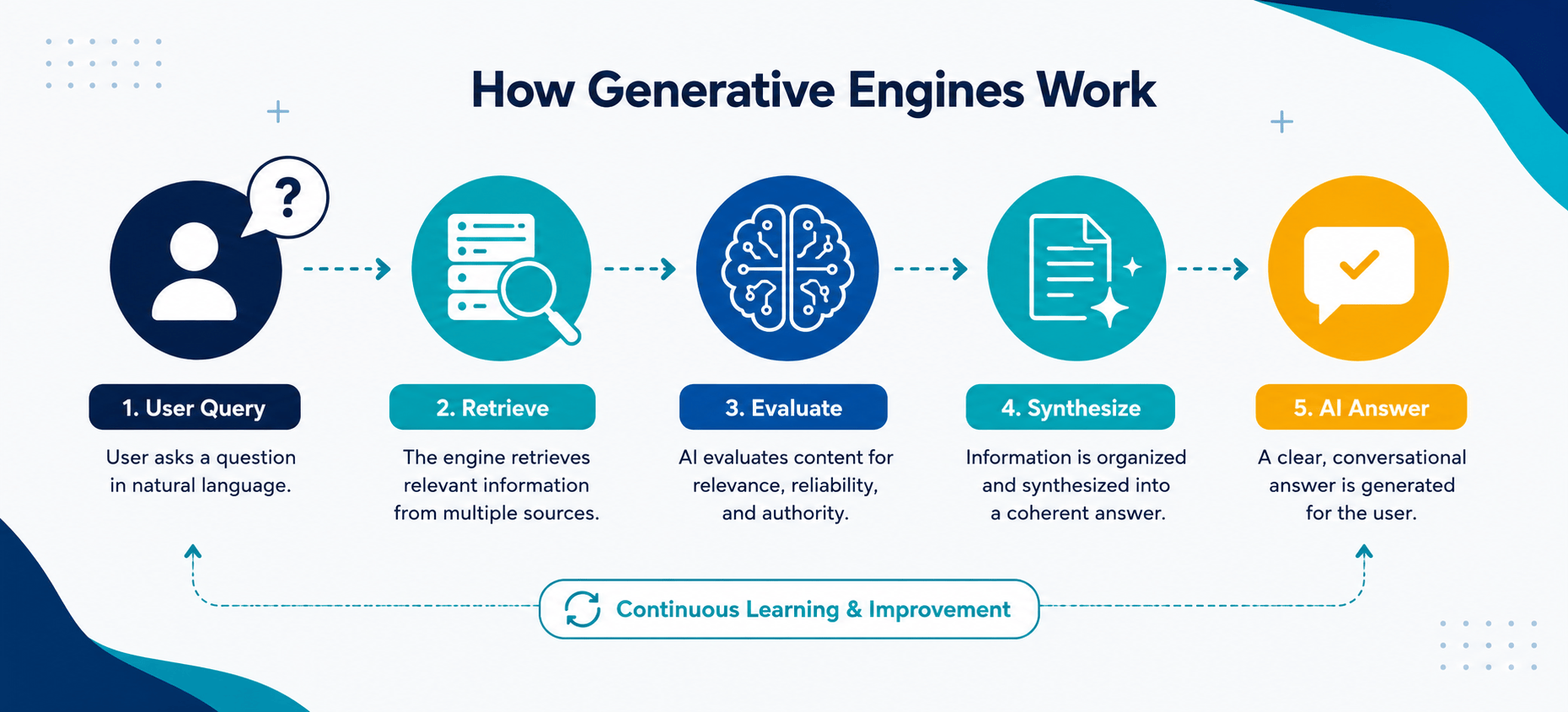
How Generative Engines Work
Understanding GEO requires a basic understanding of how modern generative search experiences can produce answers.
The exact architecture varies between platforms, but the general process may involve several stages.
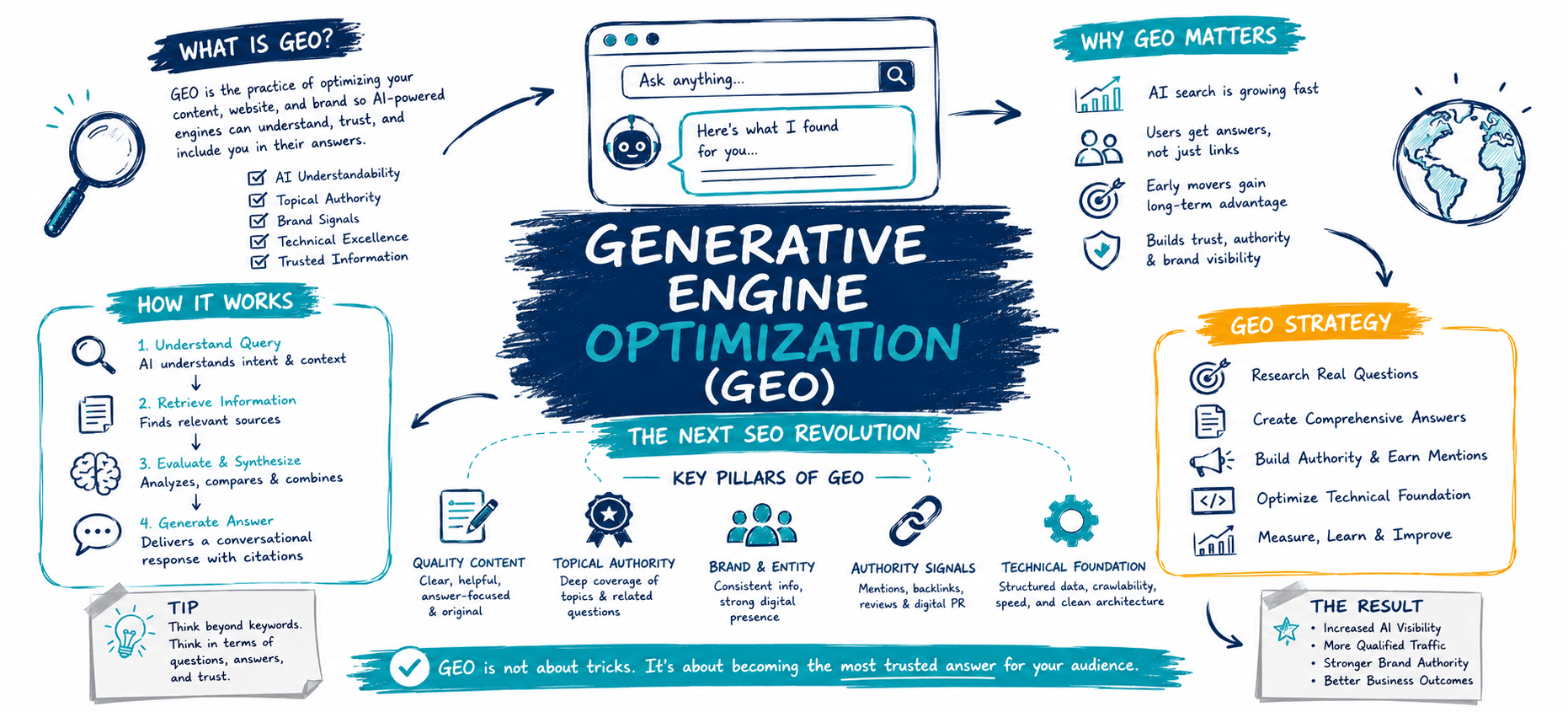
1. Understanding the user’s query
The system interprets the user’s words, intent, context, and possible expectations. It may understand synonyms, entities, relationships, previous conversation context, and complex natural-language questions.
2. Retrieving relevant information
Depending on the platform and query, the system may retrieve information from indexed webpages, databases, knowledge sources, search results, product information, or other accessible resources.
3. Evaluating information
The system attempts to identify relevant information that can contribute to the answer. Clear, specific, well-structured, authoritative information is generally easier to interpret than vague or poorly organized content.
4. Synthesizing an answer
Instead of presenting only a list of sources, generative systems may combine information into a natural-language response.
5. Referencing sources
Some AI search experiences display citations or links that allow users to investigate the original sources. Others may mention brands, products, services, organizations, or experts directly within the response.
From a GEO perspective, the goal is to make your information sufficiently useful, accessible, credible, and distinctive that it can contribute meaningfully to these processes.
Why Businesses Need GEO
Businesses should pay attention to GEO because AI-assisted discovery is creating additional touchpoints across the customer journey.
Consumers increasingly use conversational tools to research products, understand complicated topics, compare solutions, create shortlists, analyze alternatives, and make purchasing decisions.
GEO can increase brand discovery
A company that appears in an AI-generated recommendation can reach users who may never have discovered it through traditional search results.
GEO can influence early-stage decisions
AI tools are frequently used for informational and exploratory questions. These conversations can shape a buyer’s shortlist before they visit a product or service website.
GEO supports brand authority
Creating well-researched, accurate, comprehensive content improves the digital knowledge available about a brand and its expertise.
GEO can strengthen existing SEO efforts
Content designed around clear answers, topical depth, user intent, structured information, and credible sources can also perform well in conventional organic search.
GEO can create a competitive advantage
Many companies still focus entirely on keywords and rankings. Businesses that begin developing AI visibility strategies earlier can build content libraries, authority signals, third-party mentions, and entity recognition before competition becomes more intense.
Core Elements of a Successful GEO Strategy
Generative Engine Optimization requires a broader approach than inserting keywords into webpages. A successful strategy combines content quality, technical accessibility, brand authority, entity consistency, and reputation signals.
Topical authority
Your website should demonstrate meaningful expertise around the subjects closely connected with your products, services, industry, and customer problems.
Instead of publishing disconnected articles, build topic clusters that comprehensively address important customer questions.
Answer quality
Pages should provide clear and useful responses. Avoid unnecessary filler before answering the primary question.
Unique information
Original research, proprietary data, expert commentary, case studies, surveys, experiments, benchmarks, and first-party insights can make your content more valuable than generic summaries.
Credibility
Show who created the content, why they are qualified, when information was updated, and what evidence supports important claims.
Entity clarity
Your brand name, services, locations, leadership, expertise, products, and relationships should be communicated consistently across your digital properties.
External authority
A company describing itself as the best provider is less convincing than independent websites, publications, communities, customers, analysts, and industry sources discussing its expertise.
Technical accessibility
Important information should be published in accessible HTML and organized logically so search systems can crawl, understand, and retrieve it efficiently.
Content Strategy for Generative Engine Optimization
Content is one of the most important components of GEO. However, producing more articles is not enough. Content needs to become easier to understand, retrieve, quote, summarize, and connect to a specific topic or entity.
Answer questions directly
When a section asks a question, provide the core answer near the beginning. Additional detail can follow afterward.
For example, instead of spending several paragraphs introducing conversion rate optimization before defining it, immediately explain what CRO means and why it matters.
Write for conversational search intent
Users interacting with AI engines often use detailed natural-language questions. Your content strategy should therefore include long-tail queries and decision-oriented questions.
- What is the best option for a specific business type?
- How does one solution compare with another?
- What are the advantages and disadvantages?
- How much does implementation typically involve?
- Which solution is appropriate for beginners?
- What should businesses consider before choosing a provider?
Develop topic clusters
Create a central authoritative resource around an important subject and support it with specialized articles that answer related questions.
For example, an ecommerce marketing agency might build a topic cluster around ecommerce growth containing dedicated resources on paid advertising, SEO, conversion optimization, retention, marketplace marketing, customer acquisition, and analytics.
Include comparison content
Users frequently use AI tools to evaluate options. Publish transparent comparisons showing where products, platforms, strategies, or approaches are suitable and where they are not.
Publish original research
Unique datasets can strengthen both GEO and traditional digital PR efforts.
Examples include industry surveys, customer behavior studies, performance benchmarks, market reports, trend analysis, and anonymized internal data.
Update important content regularly
Outdated pricing, statistics, screenshots, regulations, product features, or industry information can reduce trust. High-value evergreen resources should have a review and update process.
Entity Authority, Brand Signals, and Digital Reputation
One of the biggest differences between simplistic keyword optimization and modern search optimization is the importance of entities.
An entity can be a company, person, product, location, concept, organization, or other identifiable thing.
Search and AI systems benefit from understanding not only individual words but also relationships between entities.
For example, they may try to understand what your company does, where it operates, what services it provides, who its customers are, what industries it serves, who leads the organization, and how external sources describe the company.
Maintain consistent brand information
Company descriptions, names, locations, contact information, services, and important brand facts should remain consistent across major digital platforms.
Create a strong About page
Your About page should explain your company’s identity, history, expertise, leadership, capabilities, locations, and market focus clearly.
Build authoritative team profiles
Expert authors and leadership pages can help establish the people associated with your organization’s expertise.
Earn relevant third-party mentions
Digital PR, expert contributions, industry publications, partnerships, events, directories, podcasts, research collaborations, and legitimate editorial mentions can strengthen brand recognition.
Improve review visibility
Customer reviews can influence both user trust and the overall information ecosystem surrounding your brand.
Companies should encourage genuine reviews on platforms relevant to their business while responding professionally to customer feedback.
Technical GEO: Making Content AI-Friendly
Excellent content still needs to be accessible. Technical optimization ensures that search engines and other systems can efficiently discover and interpret your website.
Use clear HTML structure
Organize pages with logical headings, paragraphs, lists, tables where appropriate, descriptive links, and accessible HTML.
Implement relevant structured data
Schema markup can help search engines understand the meaning and relationships within a webpage.
Depending on the website, useful structured data types may include:
- Organization
- LocalBusiness
- Product
- Article
- BreadcrumbList
- Person
- Event
- VideoObject
Structured data should accurately represent information visible on the webpage and should not be treated as a shortcut for building authority.
Improve internal linking
Internal links help establish relationships between content pieces and guide users toward deeper information.
Maintain crawlability
Important public content should not accidentally be blocked from crawlers through configuration errors, broken navigation, authentication requirements, or incorrect directives.
Improve performance and mobile usability
Fast, usable, mobile-friendly websites continue to support the overall quality of the user experience.
Keep important information in accessible page content
Avoid hiding essential information exclusively inside images, difficult interactive components, or formats that are unnecessarily hard to parse.
GEO Keyword and Query Research
Traditional keyword research remains useful, but GEO expands research toward questions, conversations, entities, tasks, comparisons, and decision journeys.
Start with traditional search demand
Identify high-value commercial keywords, informational topics, customer problems, and product categories relevant to your business.
Expand keywords into conversations
Convert core topics into realistic questions customers may ask an AI assistant.
A keyword such as “Shopify SEO agency” could generate questions including:
- How do I choose a Shopify SEO agency?
- What services should a Shopify SEO agency provide?
- Is hiring a Shopify SEO agency worth it?
- How long does Shopify SEO take?
- What should Shopify SEO cost?
- How does Shopify SEO differ from standard ecommerce SEO?
Research comparison queries
Identify alternatives, competitor comparisons, versus searches, category comparisons, and “best for” questions.
Research follow-up questions
Generative search encourages conversation. Consider what users will ask immediately after receiving the first answer.
If the initial query is “What is GEO?”, natural follow-ups might include “How is GEO different from SEO?”, “How do I optimize my website for AI?”, and “How can I measure AI visibility?”
A strong content strategy should answer the entire question journey rather than one isolated keyword.
How to Optimize for ChatGPT, Gemini, and AI Search Engines
There is no universal trick that guarantees a brand will appear in responses from ChatGPT, Gemini, or other AI-powered search experiences. Each platform has its own systems, sources, retrieval methods, models, and product features.
However, businesses can improve the quality and discoverability of their digital information using principles that are useful across generative search environments.
Create the strongest answer on the topic
Instead of writing only to achieve a target word count, build resources that genuinely help users complete a task or understand a decision.
Use concise answer passages
Long-form content can remain detailed while individual sections provide clear standalone answers.
Build authority outside your website
Your website should not be the only online source explaining why your company matters. Develop legitimate industry recognition through partnerships, publications, reviews, customer stories, interviews, thought leadership, and useful research.
Develop distinctive expertise
Generic AI-written content can replicate common information easily. Companies should therefore create information that reflects real-world experience, proprietary processes, data, customer outcomes, expert opinion, and unique insight.
Strengthen branded search visibility
Users who discover a company through AI may later search for the brand directly. Ensure search results for your company communicate credibility through your website, social profiles, reviews, media mentions, and useful brand information.
Monitor how AI systems describe your brand
Periodically test representative prompts related to your category. Compare whether your company appears, how it is described, which competitors are recommended, and what sources are referenced.
A Practical GEO Content Framework
A consistent content framework can make GEO easier to implement across a website.
Step 1: Define the primary question
Every article or page should have a clear purpose. Identify the central question or decision it needs to support.
Step 2: Provide the direct answer
Give users the most important information quickly instead of forcing them through a long introduction.
Step 3: Define important terminology
Clearly explain industry concepts, acronyms, products, technologies, processes, and entities.
Step 4: Add supporting evidence
Use credible statistics, original research, industry standards, expert knowledge, data, and examples where appropriate.
Step 5: Include practical context
Explain when a strategy works, who it is suitable for, what limitations exist, and what users should consider.
Step 6: Cover related questions
Build semantic depth by answering closely connected user questions instead of repeating the same keyword.
Step 7: Add real experience
Include examples, workflows, case studies, experiments, lessons learned, expert commentary, or anonymized customer scenarios.
Step 8: Build internal links
Connect the article with relevant service pages, guides, research, case studies, and related resources.
Step 9: Review accuracy
Check claims, citations, names, statistics, dates, and technical explanations before publication.
Step 10: Keep the page current
 Schedule periodic reviews for important content, especially in fast-changing industries.
How to Measure GEO Performance
Measuring Generative Engine Optimization can be more complex than measuring traditional rankings because generative answers may vary based on prompt wording, user context, platform behavior, location, freshness, and other factors.
Businesses should therefore use a combination of visibility and commercial metrics.
AI brand mentions
Track whether your organization appears in responses for high-value category questions.
AI citation visibility
Where platforms provide sources, monitor whether your pages are being referenced.
Competitive share of voice
Compare how frequently your brand appears against key competitors for representative prompts.
Referral traffic
Use analytics platforms to monitor referral traffic from AI tools where identifiable.
Branded search growth
Increased discovery through external channels may contribute to more people searching directly for your company, products, experts, or services.
Assisted conversions
Customers may discover a brand through generative search and convert through another channel later. Attribution analysis should therefore consider assisted journeys rather than only last-click conversions.
Content citation rate
Track which types of pages are most frequently referenced and identify patterns in their structure, depth, freshness, authority, or subject matter.
Revenue and qualified leads
Ultimately, GEO should support business outcomes. AI visibility is useful only when it contributes to awareness, demand generation, qualified opportunities, customer acquisition, retention, or revenue.
Common GEO Mistakes to Avoid
As GEO becomes more popular, businesses may look for shortcuts. Many of these tactics fail because they focus on manipulating AI systems instead of creating a stronger information ecosystem.
Publishing large volumes of generic AI content
Using generative tools to produce hundreds of near-identical articles without meaningful expertise can create a weak content library.
AI can assist research, outlining, editing, summarization, and content production, but important content should still provide real value.
Ignoring traditional SEO
GEO does not eliminate the need for crawlability, indexing, internal links, authority, technical quality, keyword research, or useful content.
Overusing keywords
Generative systems are designed to understand context and meaning. Repeating the same phrase unnaturally does not create expertise.
Publishing unsupported claims
Claims such as “number one agency” or “best platform” are less persuasive without evidence.
Ignoring external reputation
Optimizing only your website while neglecting reviews, public profiles, publications, expert mentions, directories, and industry presence creates an incomplete GEO strategy.
Creating fake statistics
Never invent research data to make content appear authoritative. Use reliable sources or clearly identified first-party data.
Obsessing over individual AI prompts
Generative responses can vary. Rather than optimizing around one exact prompt, build comprehensive authority around important topics and customer questions.
GEO for Ecommerce and D2C Brands
Generative search could play an important role in product discovery and comparison, making GEO particularly relevant for ecommerce and direct-to-consumer brands.
Customers can use AI tools to ask increasingly specific product questions such as “What are the best running shoes for beginners with flat feet?” or “Which skincare product is suitable for oily skin in humid weather?”
This means ecommerce GEO must extend beyond optimizing product titles.
Create detailed product information
Product pages should clearly communicate features, materials, dimensions, ingredients where relevant, use cases, compatibility, benefits, care instructions, limitations, shipping information, and other purchasing details.
Use structured product data
Accurate structured data can help search systems understand product information such as availability, ratings, pricing, and identifiers when supported and implemented appropriately.
Create buying guides
Publish educational content that helps customers select the right product based on specific needs.
Build comparison pages
Transparent comparisons can address high-intent searches while giving AI systems structured information about product differences.
Collect genuine reviews
Customer experiences provide useful trust signals and may help future buyers understand common use cases, strengths, and limitations.
Optimize marketplace presence
D2C brands selling across marketplaces should maintain accurate and consistent product information across relevant channels.
Publish real customer stories
Case studies, demonstrations, user-generated content, testimonials, and before-and-after examples can create information that generic competitor pages may lack.
GEO for B2B and Service Businesses
B2B companies and professional service providers can benefit significantly from GEO because their customers often conduct extensive research before contacting a vendor.
Generative tools can help potential customers understand services, compare suppliers, create vendor shortlists, estimate requirements, and identify questions to ask during procurement.
Build authoritative service pages
Each important service should have a detailed page describing the problem it solves, process, deliverables, ideal customer, expected outcomes, frequently asked questions, and relevant proof.
Create industry-specific expertise
Demonstrate knowledge of customer industries through specialized guides, case studies, compliance information, workflows, examples, and challenges.
Publish case studies
Detailed case studies can be exceptionally valuable because they contain specific evidence.
A strong case study may include:
- Client situation
- Business challenge
- Strategy
- Implementation
- Timeline
- Results
- Lessons learned
Show subject-matter experts
Highlight the experience of consultants, engineers, strategists, executives, developers, marketers, or other relevant professionals.
Answer procurement questions
Create content covering pricing models, implementation timelines, onboarding, integrations, service-level expectations, methodology, and vendor evaluation.
These questions frequently appear during later stages of the B2B buying journey and can create highly valuable search visibility.
The Future of GEO and Search Marketing
GEO is unlikely to remain a separate marketing tactic forever. Instead, many of its principles are likely to become part of broader organic visibility, brand strategy, content marketing, reputation management, and search optimization.
The most important shift is from optimizing only for search rankings toward optimizing for digital understanding.
Search strategies will become multi-platform
Customers may discover brands through traditional search engines, AI assistants, social platforms, ecommerce marketplaces, communities, video platforms, review sites, and specialized search tools.
Marketers will need to understand where their audience discovers information rather than treating Google rankings as the only measure of organic visibility.
Brand authority may become increasingly valuable
As generic content becomes easier to produce, strong brands with original expertise, recognized experts, unique research, trusted customer relationships, and consistent third-party validation can differentiate themselves.
Original data will become more valuable
AI can summarize existing information easily. Creating new information is harder.
Organizations capable of producing original research, experiments, benchmarks, frameworks, case studies, and expert insight can give other websites and AI systems reasons to reference them.
Content teams will optimize for answers and journeys
Traditional keyword maps may evolve into intent maps showing the questions users ask throughout research, comparison, evaluation, purchase, onboarding, and retention.
SEO professionals will become broader information strategists
Future organic growth teams may work across technical SEO, content architecture, digital PR, brand reputation, analytics, entity optimization, structured data, and AI visibility.
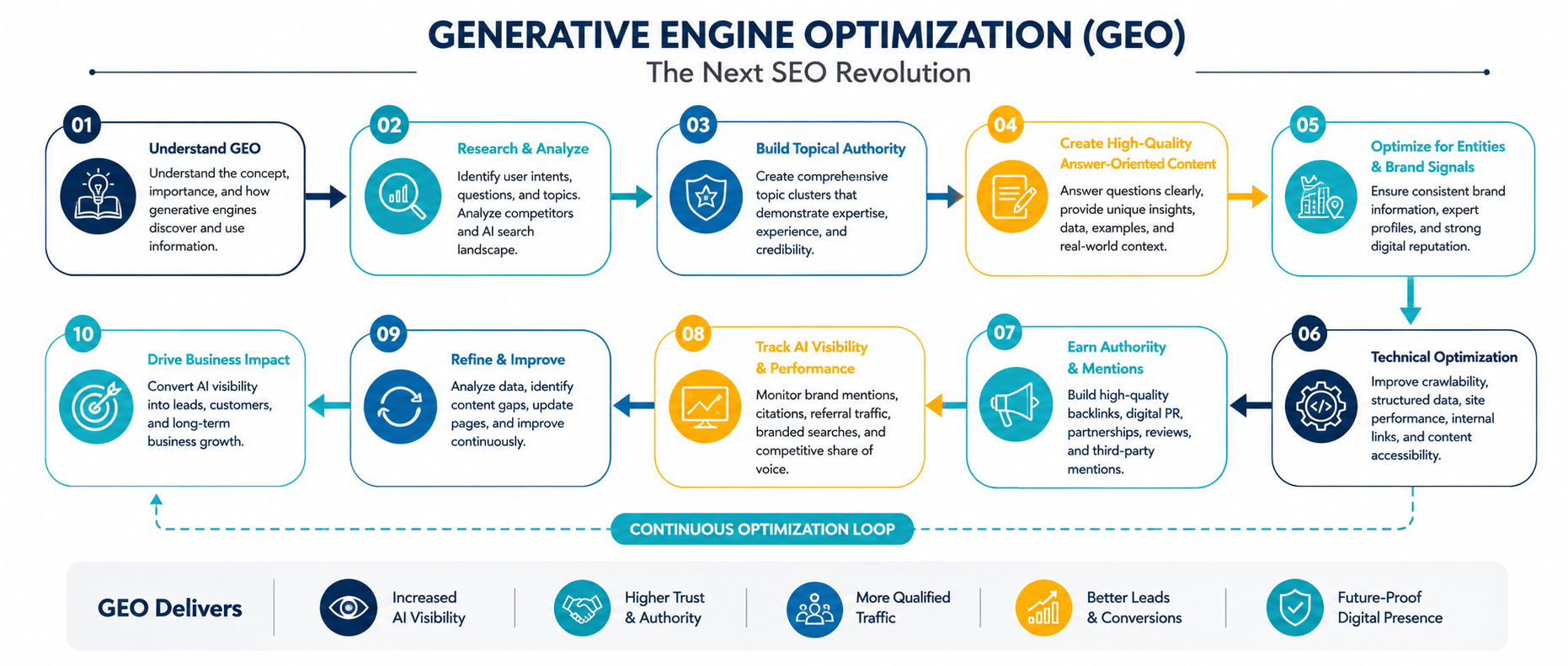
Step-by-Step GEO Action Plan
Businesses do not need to rebuild their entire digital strategy overnight. GEO can be implemented systematically alongside existing SEO efforts.
Step 1: Audit your current AI visibility
Create a representative set of prompts connected to your products, services, customer problems, industry, and competitors. Evaluate whether your brand appears and which sources are frequently referenced.
Step 2: Audit your digital entity
Review whether important information about your business is consistent across your website, business profiles, social channels, directories, publications, and other relevant sources.
Step 3: Identify priority topic clusters
Select subjects where your organization has genuine expertise and commercial relevance.
Step 4: Map customer questions
For each topic, identify informational questions, comparisons, objections, purchasing questions, implementation questions, and post-purchase concerns.
Step 5: Upgrade existing high-value content
Improve important articles and landing pages with direct answers, examples, original expertise, stronger evidence, clearer formatting, updated information, useful FAQs, and internal links.
Step 6: Create missing decision content
Publish resources targeting comparisons, alternatives, buyer guides, evaluation criteria, use cases, pricing considerations, and implementation questions.
Step 7: Build original authority assets
Produce research reports, benchmark studies, expert interviews, calculators, templates, tools, frameworks, and detailed case studies.
Step 8: Strengthen digital PR
Earn relevant editorial coverage by contributing useful data, expert commentary, research, and stories to authoritative industry publications.
Step 9: Improve technical foundations
Review crawlability, indexability, structured data, internal linking, mobile performance, page speed, canonicalization, metadata, sitemap quality, and content accessibility.
Step 10: Build a measurement dashboard
Track traditional organic performance alongside AI mentions, citations, referral traffic, branded searches, assisted conversions, and competitive visibility.
Step 11: Test and refine
GEO is an evolving discipline. Review performance regularly and improve your strategy based on user behavior, platform changes, and observed results.
Frequently Asked Questions About GEO
What does GEO stand for in digital marketing?
GEO stands for Generative Engine Optimization. It refers to the process of improving digital content and brand authority so information can be more easily understood, retrieved, and potentially referenced by AI-powered search and generative answer engines.
Is GEO replacing SEO?
No. GEO is better viewed as an extension of modern SEO. Traditional search engines remain important, while AI-powered discovery creates additional opportunities for brands to gain visibility.
What is the main difference between SEO and GEO?
SEO traditionally focuses on ranking webpages in search results, while GEO adds the objective of making content and entities understandable and authoritative enough to contribute to AI-generated responses.
Can GEO help a brand appear in ChatGPT?
A strong GEO strategy can improve the overall availability, clarity, credibility, and authority of information about a brand, but no optimization technique can guarantee inclusion in a specific ChatGPT response.
Does structured data improve GEO?
Structured data can help machines understand entities and webpage information more clearly, making it a useful technical foundation. However, structured data alone does not guarantee AI visibility.
Are backlinks still important in GEO?
Authoritative links and mentions remain valuable because they can contribute to discoverability, reputation, referral traffic, traditional SEO performance, and broader brand authority.
How long does GEO take to work?
There is no fixed timeline. Results depend on existing brand authority, content quality, technical foundations, competition, industry, and how different AI platforms discover and use information.
Can small businesses use GEO?
Yes. Small businesses can focus on specialized expertise, local authority, customer reviews, detailed service content, unique insights, and highly specific customer questions where larger competitors may have less focused information.
What type of content works best for GEO?
Useful GEO content can include comprehensive guides, original research, FAQs, comparisons, case studies, expert analysis, product information, tutorials, definitions, statistics, industry reports, and decision-support content.
How can businesses track GEO?
Businesses can monitor AI mentions, citations, referral traffic, branded search demand, competitive share of voice, assisted conversions, and performance across a controlled group of representative prompts.
Conclusion: Preparing Your Brand for the Generative Search Era
Generative Engine Optimization represents an important evolution in how businesses should think about organic visibility.
Traditional SEO asks whether a webpage can rank for a search query. GEO adds another question: when an AI system needs information about your industry, problem, service, product, or category, does the digital ecosystem provide enough credible evidence for your brand to become part of the answer?
Winning in generative search will not come from a single optimization trick. It requires a strong website, valuable content, clear entity information, trustworthy expertise, external authority, technical accessibility, original insights, and a consistent digital reputation.
Companies should continue investing in SEO while expanding their strategy toward AI discovery. Build content around real customer questions. Create information worth referencing. Publish unique expertise. Strengthen your reputation beyond your own website. Make your content technically accessible and easy to understand.
The search landscape may continue changing, but one principle remains constant: the brands that provide the clearest, most credible, most useful information are best positioned to earn attention.
GEO is therefore not simply another digital marketing trend. It represents a broader shift from optimizing for rankings to optimizing for relevance, authority, understanding, and influence across an AI-powered discovery ecosystem.


 64
64